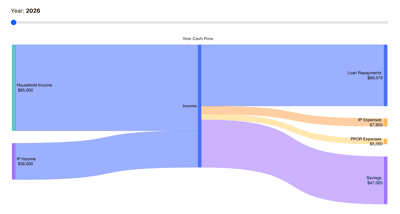
What Is a Sankey Cash Flow Diagram? How to Read One
A Sankey cash flow diagram shows where every dollar of income goes. Learn how to read one, what it reveals that a budget can't, and how to build your own.
September 2, 2026
Leading Monarch Money alternatives in 2026 include:
- Empower Personal Dashboard: free net worth, budgeting and cash flow tracking from linked accounts, plus a retirement planner.
- Calm Sea: a forward-looking planner that projects net worth, property and loans, with retirement drawdown and Monte Carlo simulation, and no bank linking. Free plan, or $12/mo or $99/yr.
- ProjectionLab: detailed FIRE modelling. Free Basic plan with Monte Carlo, Premium $129/yr.
- Boldin: US retirement planning with tax and Social Security tools. Free Basic plan, PlannerPlus $168/yr.
- A spreadsheet: free, private and fully under your control.
Monarch Money itself remains one of the strongest choices for day-to-day budgeting with automatic account syncing and a shared view for couples.
Monarch Money, Empower, ProjectionLab and Boldin features and prices checked November 2026 on each company's own website.
| Alternative | Best for | Price |
|---|---|---|
| Empower | Free tracking with sync | Free |
| Calm Sea | Long-range plans, property | Free, or $12/mo |
| ProjectionLab | Detailed FIRE modelling | Free, or $129/yr |
| Boldin | US retirement and tax | Free, or $168/yr |
| Spreadsheet | Full DIY control | Free |
For comparison, Monarch Money's Core plan costs $14.99 a month or $99.99 a year after a 7-day free trial, and Monarch Plus costs $199.99 a year. Monarch has no free plan. Each alternative is covered in more detail below, after the Calm Sea vs Monarch Money comparison.
Monarch Money is one of the most popular budgeting apps in the US. It pulls your bank accounts, credit cards, loans and investments into one place, categorises your spending and lets you budget with a partner. Many people moved to it when Mint shut down. Even so, plenty of people search for Monarch Money alternatives.
Some want a free option. Some live outside the US and Canada, where Monarch doesn't advertise support. Some would rather not link their bank logins at all. And a growing group, especially people chasing financial independence, realise that a budgeting app answers "where did my money go?" but not "when can I stop working?"
This guide lists the main Monarch Money alternatives, then compares Calm Sea and Monarch Money side by side. It's written by the Calm Sea team, so we've tried hard to be fair. Monarch facts come from its own pricing page, homepage and feature pages, and we say plainly where Monarch does more than Calm Sea. If you want the wider field, our roundup of the best FIRE tracking apps compares six options.
Test your plan with a free Monte Carlo calculator
See how likely your retirement savings are to last across 1,000 simulated markets. No sign-up, no bank linking.
Monarch Money is a budgeting-first personal finance app. Its homepage says it connects to more than 13,000 financial institutions through several data providers, so balances and transactions update automatically. Once accounts are connected, you can see spending by category, track a budget, set savings goals, and follow your net worth trend over time.
Monarch has two plans, as of November 2026 (Monarch pricing):
Both plans start with a 7-day free trial, and Monarch offers a money-back guarantee. You can invite a partner or a financial professional to collaborate at no extra cost, which is one of its most-loved features for couples.
Monarch is available in the US, and its website has a dedicated page announcing that it's now available in Canada, with prices billed in US dollars. Its site doesn't mention support for the UK, Europe or other countries.
Monarch is a well-made product, so the reasons people look elsewhere are mostly about fit rather than flaws.
No free plan. Monarch is a paid subscription after the trial. Free tools such as Empower Personal Dashboard, or the free tiers of planners like Calm Sea and ProjectionLab, cost nothing to keep using.
Living outside the US or Canada. Account syncing depends on connections to local banks. People in the UK, Europe, Australia and elsewhere often find their institutions aren't supported, which removes much of the reason to pay for a sync-first app. That's why "Monarch Money alternative for Europe" and "Monarch Money UK alternative" are common searches.
Not wanting to link accounts. Automatic syncing is convenient, but it means sharing access to your bank and investment accounts with a third party. Some people would rather enter a handful of balances themselves each month.
Budgeting isn't the main question. Budgeting looks backwards at what you spent. People planning for retirement or financial independence need to look forward: how big their portfolio could grow, when it could cover their spending, and how long it could last once they stop working. Monarch's forecasting sits in the Plus plan, and its site doesn't mention Monte Carlo simulation or retirement drawdown modelling.
Calm Sea and Monarch Money solve different problems, so the table shows where each one is focused. "Not stated" means the vendor's own website doesn't mention the capability. It doesn't necessarily mean the feature is missing.
| Feature | Calm Sea | Monarch Money |
|---|---|---|
| Free plan | Yes, Simple (no saving) | No, 7-day trial |
| Paid price | $12/mo or $99/yr | $14.99/mo or $99.99/yr |
| Bank syncing | No, manual entry | Yes, 13,000+ banks |
| Budget categories | No | Yes |
| Transaction tracking | No | Yes |
| Net worth | Yes, projected forward | Yes, trend |
| Long-range projections | Yes | Forecasting (Plus) |
| Monte Carlo | Yes | Not stated |
| Retirement drawdown | Yes | Not stated |
| Property and loans | Yes, equity and LTV | Real estate accounts |
| Country coverage | Several (manual entry) | US and Canada |
A few notes on the table:
An honest comparison has to say where the other tool does more. Monarch is ahead in several areas.
Monarch is built for budgeting. Transactions sync and get categorised automatically, and you can budget by category, review spending trends and set up rules. Calm Sea doesn't do any of this. If knowing what you spent on groceries last month is the main job, Monarch is the better tool. Our guide to the 50/30/20 budget rule covers one simple way to structure a budget, whichever app you use.
Because Monarch connects to thousands of institutions, your balances stay current without any typing. For households with many accounts, that saves real time.
Monarch lets you invite a partner, or a financial professional, to see the full picture and budget together at no extra cost. Its site describes a shared view when both partners sync their accounts.
Monarch's goals let you set a target amount and monthly contribution, then assign specific savings and investment accounts to each goal, which keeps short- and medium-term saving targets visible.
Calm Sea is a planner, not a budget. It's built to answer the forward-looking questions a budgeting app leaves open.
You add your assets, liabilities, income and expenses, each with a value and a growth rate, and Calm Sea projects your net worth forward for decades. Projections can be shown in today's dollars with an inflation setting, so you can see what your future wealth is worth in real terms. That's the view used to estimate when you could reach your FI number.
Calm Sea models the drawdown phase too: how your savings and income could fund your spending through retirement, year by year, and how long your money could last. A Monte Carlo simulation then tests the plan across many randomised market scenarios (1,000 by default), so you see how likely it is to hold up rather than relying on one growth rate.
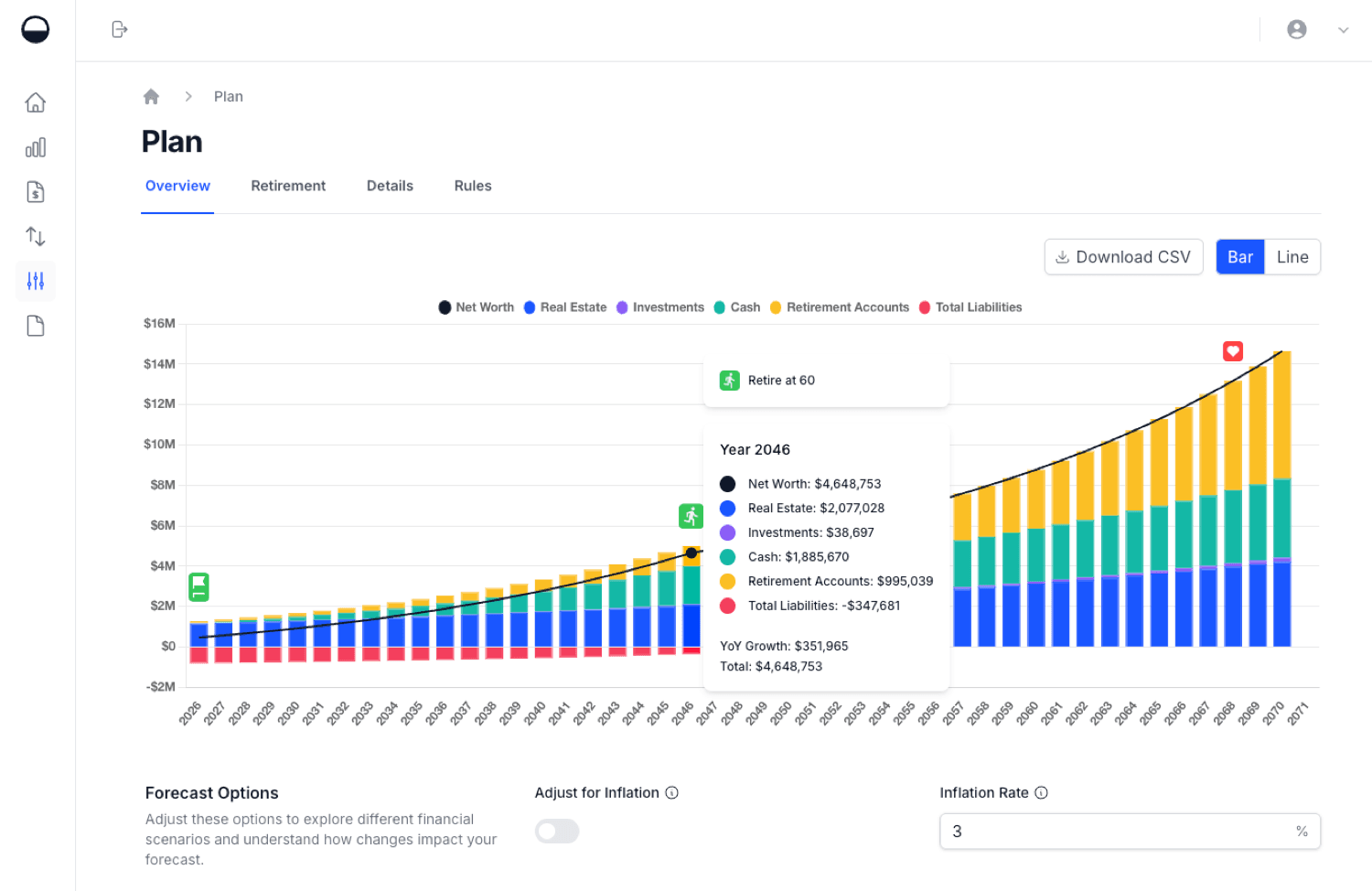
Each property sits with its value, growth rate and the mortgage secured against it, and the dashboards show equity, debt and loan-to-value ratio (LTV) over time. Our real estate guide walks through the setup.
Calm Sea never asks for bank logins, so it works the same wherever you bank. Several countries are supported, which makes it a practical Monarch Money alternative for people in the UK, Europe and elsewhere. The trade-off is that you update balances yourself, which many people do monthly or quarterly. Our guide on how to track net worth covers a simple routine.
See everything it tracks on the Calm Sea FIRE tracking app page.
| If you want to... | Better fit |
|---|---|
| Budget by category and track spending | Monarch Money |
| Sync every account automatically | Monarch Money |
| Budget together as a couple | Monarch Money |
| See when you could retire | Calm Sea |
| Test a plan with Monte Carlo | Calm Sea |
| Put property, mortgages and LTV first | Calm Sea |
| Plan without linking bank accounts | Calm Sea |
| Plan outside the US and Canada | Calm Sea |
Monarch Money is best for US and Canadian households who want to run their day-to-day money in one app, with automatic syncing, budgets and a shared view for couples.
Calm Sea is best for people who want to see where their wealth is heading, including property and loans, when they could reach financial independence and how long their money could last, without linking bank accounts.
The two aren't mutually exclusive. Plenty of people budget in one app and plan in another, updating their planner with a few balances each quarter.
Empower Personal Dashboard is free. It links to your accounts and brings together net worth, budgeting and cash flow, transactions, portfolio analysis and a Retirement Planner (Empower tools). It's the closest free match to Monarch's sync-everything approach. The trade-off is that the dashboard is offered by Empower, which also sells paid advisory services. Our Empower alternative guide compares it with Calm Sea in depth.
ProjectionLab is a detailed long-range planner. Its free Basic plan includes Monte Carlo simulation and historical backtesting, and Premium, at $129 a year, adds cash-flow projections, tax estimation, withdrawal strategies and international planning. It doesn't link to your accounts. It suits people who want to model their FIRE plan in depth; our ProjectionLab alternative guide covers it.
Boldin is a US-focused retirement planner. Its free Basic plan builds a plan, and PlannerPlus, at $168 a year after a 14-day trial, adds Monte Carlo, connected accounts, tax planning, a Social Security explorer and a Roth conversion explorer (Boldin pricing). See our guide to Boldin alternatives for more.
A spreadsheet costs nothing and keeps everything private. You can build a budget and a simple net worth projection with a few formulas. The downsides are maintenance and the risk of broken formulas, and Monte Carlo simulation is hard to do well yourself.
A few questions usually settle the choice.
Is your main question about the past or the future? If it's "where did my money go this month?", you want a budgeting app with transaction tracking. If it's "when could I retire, and will my money last?", you want a planner with projections, drawdown and Monte Carlo.
Where do you bank? Sync-first apps are only as good as their bank connections. Outside the US and Canada, a manual-entry tool often works better than a budgeting app that can't reach your accounts.
Are you willing to link accounts? Automatic syncing saves time but shares access. Manual entry keeps your credentials private but needs a regular check-in.
What's your budget for the tool itself? Empower is free, and Calm Sea, ProjectionLab and Boldin all have free tiers. Paid plans among these options range from $99 to $199.99 a year.
What are your retirement assumptions? Whatever you choose, your withdrawal rate assumption drives the long-term projection. The 4% rule is the most widely cited reference point, and you can test different rates in the free safe withdrawal rate calculator.
See when you could reach financial independence
Project your net worth, property and loans forward, plan your drawdown and test it with Monte Carlo simulation. Free to start, no bank linking.
What is the best Monarch Money alternative?
It depends on what you use Monarch for. For free budgeting and net worth tracking with linked accounts, Empower Personal Dashboard is the closest match. For long-range planning that includes property, loans, retirement drawdown and Monte Carlo simulation without bank linking, Calm Sea is a strong fit. For detailed FIRE modelling, ProjectionLab goes furthest.
Is there a free alternative to Monarch Money?
Yes. Empower Personal Dashboard is free and links to your accounts for net worth, budgeting and cash flow. Calm Sea's free Simple plan lets you build projections without saving your data, and ProjectionLab and Boldin have free plans for retirement planning. A spreadsheet is free too.
Is Monarch Money worth it?
For US and Canadian households who want automatic syncing, detailed budgets and a shared view with a partner, Monarch Core at $99.99 a year is priced in line with other sync-based budgeting apps. If you mainly want to plan for retirement, live outside North America or prefer not to link accounts, one of the alternatives above may fit better.
Does Monarch Money work outside the US?
Monarch's website announces availability in Canada, with prices billed in US dollars, and doesn't mention other countries. Its value depends on syncing with your bank, so check whether your institutions connect during the free trial. Calm Sea is manual-entry and supports several countries, so it doesn't depend on bank connections.
Can Monarch Money help with FIRE planning?
Monarch helps with the savings side of FIRE: tracking spending, budgets, goals and your net worth trend, and Monarch Plus adds forecasting. Its site doesn't mention Monte Carlo simulation or retirement drawdown modelling, so many FIRE planners pair a budgeting app with a dedicated planner.
Calm Sea is a personal finance planning tool. Nothing in this article constitutes financial advice. Monarch Money, Empower, ProjectionLab and Boldin features and prices were checked on each company's website in November 2026 and may have changed since. Always conduct your own due diligence and consult a qualified financial adviser before making financial decisions.
A Sankey cash flow diagram shows where every dollar of income goes. Learn how to read one, what it reveals that a budget can't, and how to build your own.
September 2, 2026

An emergency fund is cash set aside specifically for unplanned expenses. Learn how much to save, where to keep it, and how it fits your broader budget.
August 25, 2026

What is an expense? Money spent to run your life or business, from rent to raw materials. See the types, examples, and how expenses differ from liabilities.
July 22, 2026

What is cash flow? The money moving in and out of your finances over time. Learn the formula, positive vs negative cash flow, and how it differs from net worth.
July 18, 2026