
Terminology
What Is an Asset? A Plain-English Guide for Personal Finance
An asset is anything you own that has financial value. Learn the different types of personal assets, how they build net worth, and how to track them effectively.
June 17, 2026

Rental yield is calculated by dividing your annual rental income by the property's value, then multiplying by 100. Gross rental yield ignores expenses. Net rental yield deducts all costs and gives you the real return. Australia's national average gross rental yield sits at around 4.69% as of early 2026, though this varies significantly by city and property type: from around 3.1% in Sydney to 6.0% in Darwin.
Rental yield is one of the first numbers any Australian property investor looks at, and for good reason. It gives you a fast, comparable way to measure how much income a property generates relative to what it costs to own. A two-bedroom unit in Brisbane might rent for a similar dollar amount to one in Melbourne's inner suburbs, but as a percentage of its purchase price, the Brisbane property could be earning significantly more.
That percentage is rental yield, and knowing how to calculate it correctly, and more importantly how to interpret it in the Australian context, separates investors who understand their returns from those who are guessing.
This guide covers the gross and net rental yield formulas, worked examples with Australian figures, city-by-city benchmarks, and the most common mistakes investors make when calculating yield.
Rental yield is a percentage that expresses how much annual income a property generates relative to its value. It is the property equivalent of a dividend yield on a share: it tells you the income return, before accounting for capital growth.
There are two versions that every investor needs to understand:
Gross rental yield uses your raw rental income before any expenses. It is quick to calculate and useful for comparing properties at a glance. It is not, however, your actual return.
Net rental yield deducts all running costs from your rental income before calculating the percentage. It is more work to calculate but far more meaningful, since it reflects what you are actually earning after the property is paid for.
Gross Rental Yield = (Annual Rental Income / Property Value) × 100
Most Australian landlords quote rent in weekly terms rather than monthly, so the formula adjusts accordingly:
Annual Rental Income = Weekly Rent × 52
Step by step:
Worked example:
You own a property in Brisbane worth $650,000. It rents for $550 per week.
Annual rental income = $550 × 52 = $28,600
Gross yield = ($28,600 / $650,000) × 100 = 4.4%
A 4.4% gross yield on a $650,000 Brisbane property. But this number tells you nothing about what you actually take home after expenses, which is where net yield comes in.
Net Rental Yield = ((Annual Rental Income - Annual Costs) / Property Value) × 100
Step by step:
Worked example:
Same $650,000 Brisbane property renting for $550 per week. Annual costs break down as:
| Expense | Annual Cost |
|---|---|
| Property management (8.5% of rent) | $2,431 |
| Landlord insurance | $1,500 |
| Council rates | $2,000 |
| Water rates | $900 |
| Maintenance (0.5% of value) | $3,250 |
| Vacancy allowance (4% of rent) | $1,144 |
| Total annual costs | $11,225 |
Net annual income = $28,600 - $11,225 = $17,375
Net yield = ($17,375 / $650,000) × 100 = 2.67%
The gross yield was 4.4%. The net yield is 2.67%. That gap is your expenses, and it is significant. A property that looks attractive on gross yield can look very different once holding costs are properly accounted for.
Note that Australian property management fees typically run between 7% and 12% of gross rent depending on the state and agent. Queensland agents commonly charge around 8-9%, while NSW agents tend to be slightly higher. Always use your actual fee when calculating net yield.
Use gross yield for a fast initial filter when comparing multiple properties. It is quick to calculate, requires no detailed cost knowledge, and is the figure most commonly used in Australian real estate listings and market reports.
Use net yield for any serious investment decision. Two properties with identical gross yields can have meaningfully different net yields depending on their strata levies (particularly for apartments), council rates by LGA, property age (older properties carry higher maintenance costs), and management structure.
The difference between gross and net yield is typically 1.5 to 2.5 percentage points for most residential investment properties in Australia. If your gross yield is 4.5%, your net yield is likely somewhere between 2% and 3%, depending on your specific cost structure.
Rental yield and cashflow are related but distinct concepts, and confusing them is one of the most common mistakes property investors make.
Rental yield answers the question: how much income does the property generate as a percentage of its value?
Cashflow answers the question: after everything is paid including the mortgage, how much money do I have left (or need to contribute) each month?
The two numbers need to be looked at together. Yield tells you about the income efficiency of the asset. Cashflow tells you about the day-to-day financial reality of owning it, and whether you can sustain the holding costs month to month.
If you are calculating yield on a property you already own rather than one you are evaluating to buy, there is an important question to answer first: are you measuring yield on your original purchase price, or on the current market value?
Yield on purchase price tells you how your return has grown relative to what you originally paid. As rents increase over time on a fixed purchase price, your yield on cost improves year by year. A property purchased in 2010 at $600,000 now worth $1.4M but renting for $800/week has a gross yield on current value of about 2.97%, but a yield on original cost of around 6.9%.
Yield on current value tells you what the property would yield if you bought it at today's price. This is the more relevant figure for comparing against alternative investments or evaluating whether to hold or sell.
Both are useful in different contexts. Most investors track both, particularly in Australian markets where long-held properties often look very different on a cost basis versus current value basis.
Forgetting body corporate or strata fees. For apartments and townhouses, body corporate fees, strata levies, or HOA fees (the name varies by country) are a real and recurring holding cost. They should always be in your net yield calculation. Leaving them out significantly overstates net yield, particularly for higher-end buildings with lifts, pools, or concierge services.
Using the wrong annualisation for your market. Rent is quoted differently depending on where you are. In Australia it is typically weekly (multiply by 52). In the US and most of Europe it is monthly (multiply by 12). Using the wrong multiplier creates a meaningful error in your annual income figure before you have even started calculating yield.
Ignoring vacancy. Assuming 100% occupancy overstates your effective rental income. A vacancy allowance of 4% to 5% is a reasonable starting assumption for well-located urban properties. In regional or higher-risk markets, 6% to 8% is more appropriate. Always factor in some vacancy rather than modelling a best-case scenario.
Comparing gross yield from one property to net yield from another. This is more common than it sounds, particularly when using yield figures from listing sites or agents (which are almost always gross) alongside your own net calculations on properties you already own. Always compare like with like.
Not separating yield from total return. Rental yield is the income component of your return. It does not include capital growth, which in many major cities is the larger driver of total return over a 15 to 20 year hold period. A 3% net yield plus 6% annual capital growth is a very different investment from a 6% net yield with flat property values. Understanding both together gives you a complete picture of what the property is actually delivering.
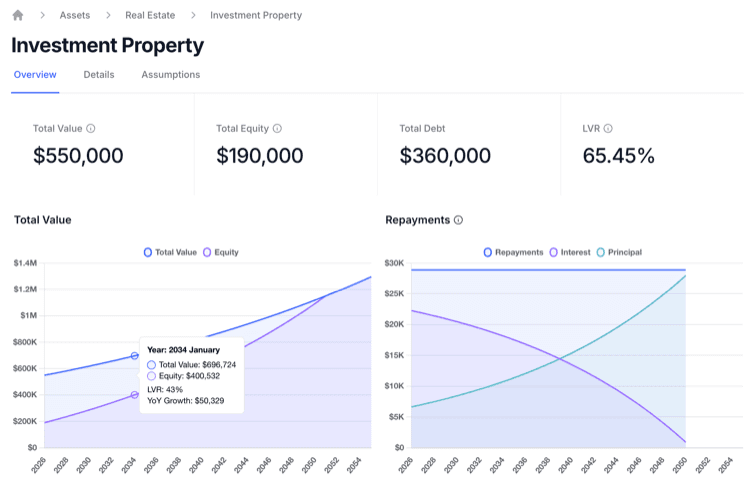
Calm Sea's rental property calculator handles the yield calculation automatically as part of its broader investment property tracking. You enter your property's current value, weekly rental income, and expense assumptions, and Calm Sea calculates gross yield in real time alongside your cashflow, LVR, equity position, and long-term projections.
Critically, Calm Sea rolls all of this up across your entire portfolio. If you own multiple investment properties, you can see the aggregate results across all of them, alongside your other assets (shares, superannuation, savings), in a single net worth view. That full picture is what tells you whether your property investments are keeping pace with your retirement goals, not just whether each individual property is yielding acceptably on its own.
Try Calm Sea free at calmsea.io
No account linking required. Free tier available. Takes about two minutes to get started.
Calm Sea is a personal finance planning tool. Nothing in this article constitutes financial advice. All projections and calculations are illustrative estimates. Always consider your own circumstances or consult a qualified financial adviser before making investment decisions.
An asset is anything you own that has financial value. Learn the different types of personal assets, how they build net worth, and how to track them effectively.
June 17, 2026

See 8 common types of liabilities, the difference between good and bad debt, and how a $450k mortgage can turn a 10% price drop into a 40% net worth hit.
June 15, 2026

Tracking your path to FIRE? Discover the must-have features, key metrics, and best apps to help you monitor progress and retire early with confidence.
June 3, 2026